30 August 2017

Quantifying the Great American Solar Eclipse 2017


During the Great American Solar Eclipse of 2017, Dr. Bruce Bugbee, president of Apogee Instruments and a professor at Utah State University, deployed a suite of sensors in the path of totality in Rexburg, Idaho to measure various environmental parameters during the eclipse. In this video, Bruce discusses his findings. The Apogee sensors he used included spectroradiometers, a net radiometer, pyranometers, full-spectrum quantum sensors, infrared radiometers, and a precision thermistor inside an aspirated radiation shield.

Download the slides from the video here >.

20 August 2017

Apogee Spectroradiometer shows eclipse glasses have about 100 times greater filtration than typical sunglasses


Apogee Quantifies the Solar Eclipse

Apogee will be on site quantifying the Great American Solar Eclipse from the center of the path of totality on August 21, 2017. As one of the biggest solar radiation events of the century, Dr. Bruce Bugbee and NYU Professor, Dr. Tyler Volk, will be manning a full suite of Apogee radiation sensors including spectroradiometers, a net radiometer, pyranometers, quantum sensors, infrared radiometers, and a precision thermistor inside an aspirated radiation shield while in Rexburg, Idaho. Stay tuned for a full report and video of their results.


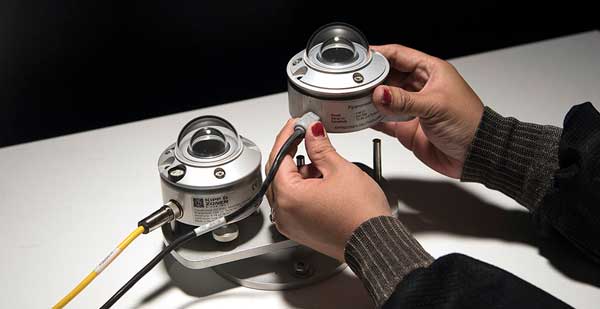
Dr Bruce Bugbee, Schuyler Smith, and Damon Nitzel preparing the Apogee sensors for monitoring the eclipse. Dr Bugbee will be taking the station to Rexburg, Idaho to make measurements from within the total coverage zone.


Dr Bruce Bugbee, Schuyler Smith, and Damon Nitzel preparing the Apogee sensors for monitoring the eclipse. Dr Bugbee will be taking the station to Rexburg, Idaho to make measurements from within the total coverage zone.


Damon Nitzel preparing Apogee sensors for monitoring the eclipse. Dr. Bugbee will be taking the station to Rexburg, Idaho to make measurements from within the total coverage zone.

19 July 2017

Introducing secondary standard, first class, and second class pyranometer calibration services from Apogee Instruments.

In addition to recalibrating quantum sensors and silicon-cell pyranometers from other companies, we now offer indoor thermopile pyranometer calibration services. Calibration complies with the ISO 9847 type llc calibration procedure and includes a calibration certificate showing the procedure, traceability, and calibration factor. (View example calibration certificate >)

Complies with ISO 9847
Calibration method is performed by our highly trained technicians and complies with type IIC of the international standard ISO 9847.

Models We Calibrate
-Kipp and Zonen models: CM 11, 21 and CMP 10, 11, 21
-Hukseflux models: SR 20 and SR 11
-Ask about additional models

Competitive Pricing
Apogee Thermopile Pyranometers   $50 + shipping
Other Companies' Thermopile Pyranometers   $195 + shipping

Repairs and Maintenance
Apogee can complete other repairs and maintenance. Call for details.

Click here for information on how to get your sensor calibrated >

10 April 2017

How to Choose the Right Oxygen Sensor

Not sure which oxygen sensor you need for your application? In this video, Schuyler Smith of Apogee Instruments, covers the different oxygen sensor models we offer, applications they are best suited for, and which accessories are needed for those applications.


07 March 2017

Weather Information Service Engine Project (WISE)

Weather Information Service Engine Project (WISE) is dedicated to resolve urban environmental issues including high-resolution weather forecasting, urban flooding prediction, road meteorology and urban carbon dynamics, and new urban service systems to minimize and mitigate the impacts of natural disasters and climate change on urban dwellers. WISE is targeting South Korea’s capitol, the megacity Seoul, and surrounding urban areas. Recently they started a project called the City Energy Monitoring System, focused on researching greenhouse gas emission from cars, buildings, and the people in Seoul City. As part of the project they are trying to analyze how concrete buildings, houses, and asphalt roads in the city interact with nature, such as rivers and parks that are in and surround the city.

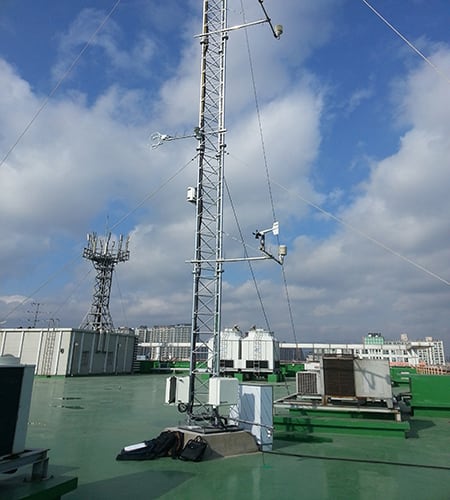
Weather station installed by B&P International for WISE project featuring Apogee SP-111 Infrared Radiometer

One of seven weather stations installed by B&P international for WISE project City Energy Monitoring System.

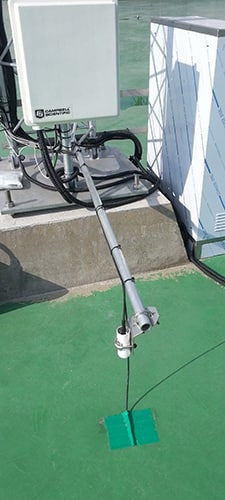
To fill this study B&P International installed seven weather stations throughout Seoul city. Six of the weather stations were installed on building roof tops, while the final station was installed in a rural area near Seoul. The stations are being used to monitor air temperature, humidity, wind, net radiation, CO2/H2O concentration etc. as well as building surface temperature. Building surface temperature is being measured with Apogee SI-111 Infrared Radiometers, temperature probes, and infra-red cameras.

AApogee Instruments SI-111 Infrared Radiometer monitors building surface temperature for WISE project

SI-111 Infrared Radiometer monitors building surface temperature.

Data collected from the temperature probe and the SI-111 at the same site are being compared and analyzed. The SI-111 is being used as the standard for accuracy, as measurements from the temperature probe may be heated by solar radiation. As the data is collected, it is transmitted to a computer at the WISE office using 4G LTE modems. From there the data is uploaded to the WISE website, where it can be viewed in real time for analysis.

More information on WISE >

Application Summary


Summary
SI-111 Infrared Radiometers measure building surface temperature as part of Weather Information Service Engine (WISE) Project.

Apogee Sensors Used
SI-111 Infrared Radiometer

Organizations
Weather Information Service Engine Project (WISE)

B&P International Co. Ltd.

Location
Seoul, Korea

27 February 2017

Monitoring PV Panels on Jin Jeop Library

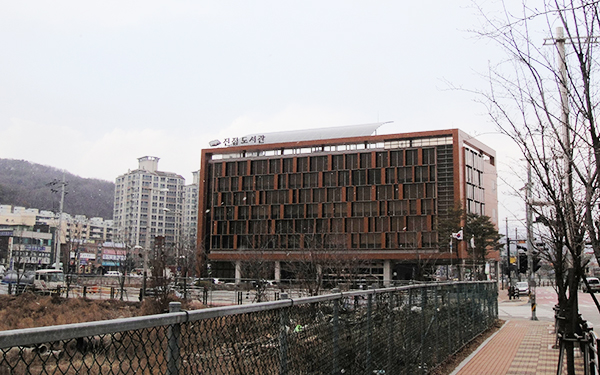
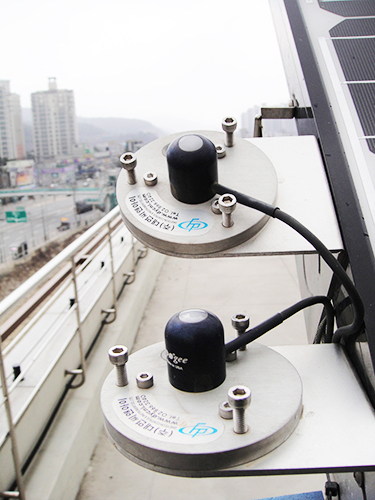
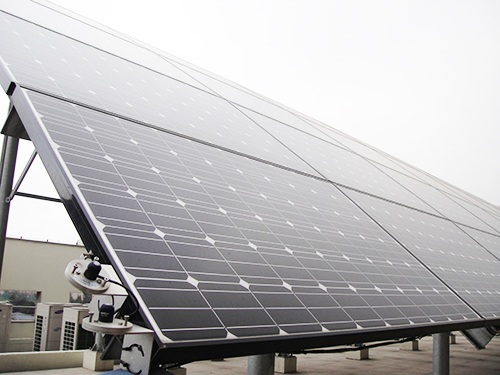
Two Apogee Instruments SP-110 Silicon-cell Pyranometers have been integrated by Daeyeon CNI as part of a PV monitoring system at the Jin Jeop library located in Namyangju city, Gyunggido, Korea. The library has a PV power generation facility on the roof of the building that is converting DC voltage to AC voltage and suppling power to the building for electric lamps, air conditioning, and water heaters.

Apogee Instruments Silicon-cell Pyranometers monitor PV Panels at Jin Jeop Library in Korea

Jin Jeop Library in Namyangju City, Gyunggido, Korea

The two SP-110 pyranometers are mounted to the side of the PV panels. One pyranometer is mounted horizontal to measure the global solar irradiance, and the other is mounted tilted in the plane-of-array to measure global tilted irradiance or plane-of-array irradiance. Although the pyranometer measuring plane-of-array irradiance is mounted at the same angle as the PV panels and is measuring the irradiance the panels are receiving, both pyranometers are being used to monitor the system.

Apogee Instruments Silicon-cell Pyranometers monitor PV Panels at Jin Jeop Library in Korea

Top pyranometer is measuring plane-of-array irradiance. Bottom pyranometer is measuring global horizontal irradiance.

The data from the SP-110 sensors allow the integrator to see when irradiance measurements for the PV panels are below the accepted threshold to maintain the PV system. They are then able to use the data from the pyranometers and other instruments that are providing panel temperature, current, and voltage data to investigate the system and fix or replace bad electronic parts and PV panels.

Apogee Instruments Silicon-cell Pyranometers monitor PV Panels at Jin Jeop Library in Korea

Apogee Instruments SP-110 Silicon-cell Pyranometers collect global horizontal irradiance and plane-of-array data to monitor the PV system at Jin Jeop Library in Korea.

Application Summary


Summary
SP-110 Silicon-cell Pyranometers are integrated as part of a PV monitoring system for a PV power generation facility on the roof of the Jin Jeop library in Gyunggido, Korea.

Apogee Sensors Used
SP-110 Silicon-cell Pyranometers

Organizations
Daeyeon CNI
B&P International Co. Ltd.

Location
Namyangju City, Gyunggido, Korea

01 February 2017

High Throughput Field Phenotyping Multi-sensor System

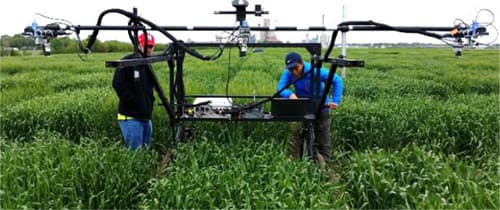
Apogee Instruments' SI-131 Infrared Radiometer (referred to in reference as thermal infrared radiometer, TIR) was selected to be part of a multi-sensor high throughput field phenotyping system for soybean and wheat breeding. The infrared radiometer was used to collect canopy temperature, one of six crop canopy sensor based traits being studied. Temperature, along with the remaining five sensor based traits: canopy height, two NDVI indices, reflectance, and RGB were studied to find a correlation with final yield.

Field phenotyping system platform feature Apogee Instruments' infrared radiometer

Field phenotyping system platform featuring Apogee Instruments' infrared radiometer.

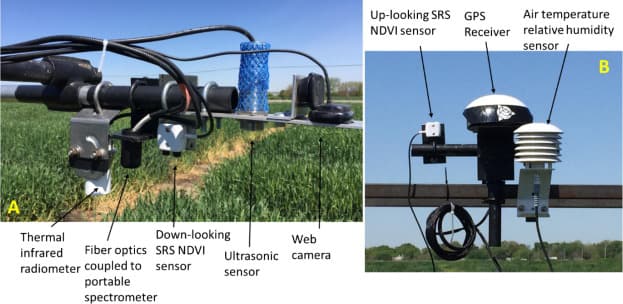
The system consisted of a manually operated platform using a laptop with a special developed LabVIEW program as a controlling unit to collect, synchronize, and store measurements from all sensors for analysis. Apogee's SI-131 was mounted to a sensor bar on the platform at a distance that allowed for a representative subarea of the crop canopy to be seen in the sensor's field of view. The analog infrared radiometer was connected to the laptop through a USB data acquisition board. The LabVIEW program read the infrared radiometer outputs from the analog input ports and applied Apogee's calibration equation to convert the sensor voltage to degrees Celsius. Yufeng Ge, a Biological Systems Engineer from the study said, "The infrared radiometer by Apogee Instruments is among one of the most reliable and trustworthy sensors I have used."

Field phenotyping system platform feature Apogee Instruments' infrared radiometer

Sensors that were mounted to the sensor bar of the platform.

The system was successfully tested over 240 plots of wheat and 120 plots of soybean crop using a manual stop-measure-go data collection method.* The study determined that final grain yield of soybean is strongly correlated with all six sensor base traits, and suggested the usefulness of the sensor system in plant breeding.

Read the Full Article >

*A stop-measure-go data collection method was used because slow response times from sensors did not allow for continuous measurement (the SI-131 with a response time of 0.6 seconds was noted as one of these sensors in the reference article). Since this study took place Apogee has developed  high speed, analog infrared radiometers with a response time of 0.2 seconds and SDI-12 infrared radiometers...more information >

Application Summary


Summary
Apogee Instruments' infrared radiometer is used to measure canopy temperature on a multi-sensor system for high throughput field phenotyping in soybean and wheat breeding.

Apogee Sensors Used
SI-131 Infrared Radiometer

Organization
University of Nebraska-Lincoln

Location
Lincoln, Nebraska

Reference Article
A multi-sensor system for high throughput field phenotyping in soybean and wheat breeding

"The Infrared Radiometer by Apogee is among one of the most reliable and trustworthy sensors I have used."
-Yufeng Ge
  Biological Systems Engineer
 University of Nebraska-Lincoln

18 January 2017

Reflectance Measurements in Cotton Fields

Dr. Glen Ritchie of the University of Georgia has used model PS-100 spectroradiometer to take reflectance measurements in cotton fields and estimate defoliation. Chlorophyll gives plant leaves a reflectance spectrum characteristically different from that of soil. Reflectance measurements can be reported in µmol m-2 s-1, W m-2, or as a relative value.

View poster presented at ASA meeting.


Spectroradiometer used for reflectance measurement

Application Summary


Summary
Estimating defoliation of cotton using reflectance data.

Sensors Used
PS-100 Spectroradiometer

Organization
University of Georgia

Location
Georgia

Original Article
Ritchie, G.L. and C.W. Bednarz. 2005. Estimating defoliation of two distinct cotton types using reflectance data. J. Cotton Sci. 9:182-188.

Poster from ASA meeting 2006

12 January 2017

Irrigation Study

Dr. Joan Girona of the Institute of Agroalimentary Research and Technology in Catalonia, Spain, is studying irrigation and the water and nutrient needs of fruit trees.

He needed to capture pyranometer readings throughout his orchard. Dr. Girona mounted Apogee pyranometer sensors and Campbell Scientific dataloggers on a carefully laid out model train track around the orchard. The train carrying the pyranometer sensors and dataloggers wound around the track and could take measurements at specified intervals. Dr. Girona could then take thousands of measurements. His system was so effective he plans to continue running it for more experiments in the future.

Learn more about Dr. Girona’s experiment by reading the original article on Campbell Scientifics’ website.

Apogee silicon-cell pyranometer used in irrigation study

Application Summary


Summary
Pyranometer mounted on model train to collect measurements in orchard for irrigation study.

Sensors Used
Silicon-cell Pyranometer

Organization
Institute of Agroalimentary Research and Technology

Location
Catalonia, Spain

Original Article
Spain: Irrigation and Solar Radiation - Campbell Scientific

06 January 2017

Controlling Flowering of Orchids in Greenhouse

Dr. Erik Runkle of Michigan State University used the SQ-313 line quantum sensor mounted on a cross bar (as shown below) in greenhouse experiments controlling the flowering of Phalaenopsis Orchids. In the experiment the SQ-313 was used to measure photosynthetic photon flux and the daily light integral at plant height for both natural and electric light sources, while temperature was experimented with to control flowering.

For the complete journal article of the experiment, click here.

Apogee line quantum used in greenhouse

Application Summary


Summary
Line quantum used to measure PPFD and daily light integral, while experimenting with temperature to control flowering of Phalaenopsis Orchids.

Sensors Used
SQ-313 Line Quantum Sensor

Organization
Michigan State University

Location
Lansing, MI

Original Article
Temperature during the day, but not during the night, controls flowering of Phalaenopsis Orchids

28 December 2016

PAR Measurements Characterize Tree Coverages

The Center for Forest Research and Extension Andean Patagonian (CIEFAP) studies forest systems and land suitable for forestry in the Andean region of Patagonia Argentina. The center does research to contribute to sustainable development in the Patagonia region. Recently, CIEFAP has been studying the relationship between tree coverage and the survival and initial growth of native Andean-Patagonian forest species.

Map showing area of study (Andes region)

The study is determining the % of PAR (under canopy/open sky) differing health of species are receiving to determine the % of PAR related to survival and initial growth. To do this study CIEFAP measured under canopy PAR using an Apogee MQ-301 line quantum sensor and open sky PAR using a ceptometer at different sites and times of day.

Finding locations to take under canopy PAR measurements using MQ-301 Apogee MQ-301 Line Quantum Meter


The results are still being evaluated, however, at this point CIEFAP has been able to determine that species receiving 50 to 60 % open sky PAR have the best survival and initial growth. Once the study is concluded CIEFAP will be able to use its data to make recommendations for the restoration of degraded forests.

Application Summary


Summary
Studying % of PAR (under canopy/open sky) and its relation to survival and initial growth of native forest species.

Sensors Used
MQ-301 Line Quantum Sensor

Organization
Center for Forest Research and Extension Andean Patagonian (CIEFAP)

Location
Andean region of Patagonia Argentina

Contributor
CIEFAP

>

21 December 2016

Solar Power on Lakes and Dams

Korea Water Resource Corporation (K-water) is the number one clean energy producer in Korea. The company operates several clean energy plants including hydropower, tidal power, wind power, and solar photovoltaic power. More recently K-water developed the world’s first ecofriendly floating solar photovoltaic power system called SOLATUS, which was installed at Hapcheon Dam. The company plans to install additional floating photovoltaic power plants on dams and lakes in Korea by 2022.

K-water's 1st SOLATUS solar power plant on Hapcheon Dam

Part of the installation process is determining the best location for the power plant. To find these locations K-water is studying solar radiation at different angles, using a configuration of eight Apogee SP-110 Silicon-cell Pyranometers, and weather data, using wind, temperature, and humidity sensors.

Close-up of Apogee SP-110 pyranometers being used to find new solar plant locations
Apogee SP-110 pyranometers being used to find new solar plant locations


Once K-water has collected all of the data from the sensors it will be reviewed to find the best location for the new power plants and the optimal angles for the solar panels to collect power throughout the day.

Application Summary


Summary
Studying solar radiation at different angles to determine locations for solar power plants.

Sensors Used
SP-110 Silicon-cell Pyranometers

Organization
K-water (Korea Water Resource Company)

Location
Korea

Contributor
K-water

13 December 2016

Forecasting Ice Formations

Campbell Scientific has incorporated our infrared radiometer sensors into a cost-effective system providing "Perugia (Italy) with portable, reliable data" for the "forecasting of ice formation on Italian road surfaces."

PDF of Project

Infrared radiometer used in crop water stress index research

Application Summary


Summary
Forecasting ice formation on road surfaces using infrared radiometers on a mobile system.

Sensors Used
SI-111 Infrared Radiometer

Organization
University of Perugia and Ecosearch

Location
Perugia, Italy

Original Article
Forecasting ice formation on Italian road surfaces

06 December 2016

Peter Sinks

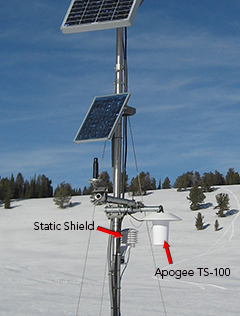
The TS-100 has been deployed for the past year on a weather station at a record-setting cold location in the contiguous United States - Peter Sinks, Utah. It is used to accurately measure the extremely cold air temperatures that occur at the site. The Peter Sinks site uses two yellow-bead thermistors and two PRTs in an Apogee TS-100 to make replicate measurements. Note the Apogee SP-230 all-season pyranometer in the picture as well.


A webinar of the TS-100 with more information on the Peter Sinks site can be found here. The Peter Sinks information starts at approximately 15:25.


Apogee TS-100 deployed at Peter Sinks, Utah

Application Summary


Summary
Used on a weather station at a record-setting cold location-Peter Sinks, Utah.

Sensors Used
TS-100 Aspirated Radiation Shield
ST-110 Thermistor
ST-300 PRT
SP-230 Pyranometer

Location
Peter Sinks, Utah

More Information
Peter Sinks Data Feed Site

Air Temperature Measurement Sensor Webinar

30 November 2016

Temperature Free-Air Controlled Enhancement (T-FACE)

This type of experiment applies a heating treatment to open-field plant canopies, simulating models of future warmer conditions. Dr. Bruce Kimball of the Arid-Land Agricultural Research Center and colleagues design and operate such experiments. In 2005 they developed a proportional–integrative–derivative control system for controlling the rise in temperatures. Apogee Infrared Radiometers provided the data on control and heated plot temperatures.

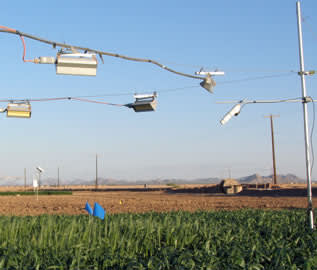
Dr. Kimball and his colleagues have developed hexagonal arrays of infrared heaters that produce uniform warming across 3-meter-diameter plots. The degree of warming is maintained using the proportional-integrative-derivative control system for controlling the rise in temperatures. Apogee Infrared Radiometers (housed in a white PVC pipe radiation shield in the photo) sense the canopy temperatures of the heated plots as well as unheated reference plots which are used by dataloggers to modulate the output of the heaters.

Similar infrared warming experimentation using this design and Apogee Infrared Radiometer sensors are also underway in Haibei, Qinghai, China; Cheyenne, WY; Ely and Cloquet, MN; Urbana, IL; Lexington, KY, and several other places around the world.


Image: Wheat warmed by infrared heaters is headed sooner in the "Hot Serial Cereal" experiment conducted by Dr. Bruce A. Kimball and colleagues at the USDA-ARS Arid-Land Agricultural Research Center and the University of Arizona at Maricopa, Arizona.

Application Summary


Summary
Simulating models of future warmer conditions by applying a heat treatment to open-field plant canopies. Apogee infrared radiometers provide the data and control the heated plot temperatures.

Sensors Used
Infrared Radiometer

Contributor
Dr. Bruce Kimball of the Arid-Land Agricultural Research Center

Location
Nebraska

Original Article
Kimball, B. A., 2005. Theory and performance of an infrared heater for ecosystem warming. Global Change Biology, 11(11):2041-2056.

Kimball BA, Conley MM, Wang S, Lin X, Luo C, Morgan J, Smith D (2008) Infrared heater arrays for warming ecosystem field plots. Global Change Biology 14, 309-320.

22 November 2016

Soil Oxygen Concentration

Dr. Wendy Yang’s Global Change Ecology Lab, at the University of Illinois at Urbana-Champaign, is currently using the Apogee SO-110 oxygen sensor, with the optional diffusion head, for quasi-continuous measurements of bulk soil oxygen concentration in managed and natural ecosystems. Their quasi-continuous field measurements of soil oxygen has allowed them to correlate soil oxygen concentrations with process rates and determine how soil oxygen concentrations relate to precipitation and soil temperature, which can drive high biological oxygen demand to induce anoxia. The Apogee SO-110 allows Dr. Wendy Yang’s Global Change Ecology Lab to collect long-term data sets in the field without fear of compromising the sensors under harsh conditions, due to the sensors ability to withstand cold winter temperatures and wet conditions.

Oxygen is a major control for reduction-oxidation reactions in soil and can lead to the production or consumption of methane and nitrous oxide, both potent greenhouse gases. Processes such as methanogens and nitrous oxide reduction to dinitrogen were once thought to be restricted to flooded or saturated soils such as those found in wetlands, however, Dr. Wendy Yang’s lab has documented the importance of these processes in unsaturated soils from upland ecosystems. Their measurements have allowed them to correlate soil oxygen concentration with process rates and determine how soil oxygen concentrations relate to precipitation and soil temperate, even under saturated soil conditions. They are currently investigating these relationships in agricultural fields in the Midwest to better understand how current land management and historical soil drainage patterns mediate soil greenhouse gas emissions.
Apogee Oxygen Sensors used by Dr. Wendy Yang Apogee Oxygen Sensors used by Dr. Wendy Yang Apogee Oxygen Sensors used by Dr. Wendy Yang
Application Summary

Summary
Quasi-continuous measurements of bulk soil oxygen concentration in managed and natural ecosystems
Sensors Used
SO-110 Oxygen Sensor
Organization
Dr. Wendy Yang's Global Change Ecology Lab
Location
University of Illinois at Urbana-Champaign

16 November 2016

Crop Water Stress Index - Case Study

Crop Water Stress Index is a means of irrigation scheduling and crop water stress quantification based on canopy temperature measurements and prevailing meteorological conditions. Plant temperature is an indicator of plant water status because stomates close in response to soil water depletion causing a decrease in water uptake and an increase in leaf temperature.

Precise measurements, particularly canopy temperature, are required. Apogee Infrared Radiometers have been used by Dr. Suat Irmak, of the University of Nebraska, in his CWSI research.

Read the full journal article Payero, J. O., S. Irmak. 2006. Variable upper and lower crop water stress index baselines for corn and soybean. Irrigation Science, 25 (1):21-32.

Infrared radiometer used in crop water stress index research

Application Summary


Summary
Using infrared radiometers to determine water schedule for plants.

Sensors Used
SI-111 Infrared Radiometer

Organization
Dr. Suat Irmak of the University of Nebraska

Location
Nebraska

Original Article
Payero, J. O., S. Irmak. 2006. Variable upper and lower crop water stress index baselines for corn and soybean. Irrigation Science, 25 (1):21-32

18 May 2016

Google's Project Loon and the Apogee SP-230 Heated Pyranometer

Apogee’s SP-230 heated pyranometer was recently selected to be part of Project Loon from Google. Project Loon is a network of high-altitude balloons developed by the Google X team that will provide streaming internet coverage from the stratosphere down to many rural and remote areas around the world. Our SP-230 pyranometer is installed on each balloon to monitor the performance of the PV panels that provide the renewable power for the electronics. The SP-230 is uniquely suited for the job because the internal heater draws only 15.4 mA at 12 V DC, yet keeps the optics clear in the icy, cold conditions of the stratosphere.

The project began with four of our sensors being purchased for testing and development in 2013 and has grown to include hundreds of SP-230s that have been delivered for deployment around the globe. Apogee Instruments is proud to be a partner in a project that will help build a truly global community.

For more information on Project Loon visit: https://www.google.com/loon/ and https://en.wikipedia.org/wiki/Project_Loon

For more information on the SP-230 Heated Pyranometer visit: http://www.apogeeinstruments.com/sp-230-all-season-heated-pyranometer/ 

A Project Loon balloon is displayed at a launch event in Christchurch, New Zealand.


Schuyler Smith
Integrator and Technical Support

Apogee Headquarters Expansion Project

Apogee recently held an open house to celebrate our 20th anniversary and the completion of our expansion project that tripled the size of our headquarters. Joining us on May 10th, 2016 were many great university colleagues, customers, partners, neighbors, construction workers, and family members. After a brief speech by company president, Dr. Bruce Bugbee, the staff provided tours of the new facility including our expanded ESD-protected production area, an improved loading and shipping area, a machine-shop, a climate-controlled calibration lab, a photo/video studio, several engineering offices, a beautiful employee break room, a state-of-the-art classroom, and a museum of antique weather instruments.

 The new facility features a highly-efficient design with large windows to utilize natural light, enhanced insulation, radiant floor heat, and louvered architectural awnings that are precisely angled at 22° to provide shade in the summer and allow the sun to pass through in winter. Along the front of the building, 17 new solar PV panels were added in a continuous arc to blend with the style of the facade. To monitor the many new building control systems, several Apogee sensors were installed, including infrared radiometers, thermistors, and pyranometers.

Apogee has come a long way since our beginning at Bruce Bugbee’s kitchen table.

Apogee Instruments
The newly expanded Apogee Instruments headquarters building located at 721 West 1800 North, Logan, Utah, 84321. The two-story section in the back was completed in April, 2016.


Jacob Bingham, Apogee's Technical Manager, explains some of the instruments in the Apogee museum to an open house guest.

One of our new webinars playing on the screen in our new classroom. 

Looking up our new staircase that leads to the engineering and R&D lab.

Devin Overly, Apogee COO (green shirt) greets several open house guests.

Guests enjoying the open house Hors d'Oeuvres in the new employee break-room.

Dr Bruce Bugbee talking with Rob Campbell, the new president of Campbell Scientific, and Ricardo Aguilar, of CS Centro Caribe. 

Dr Bruce Bugbee and Mike Stettler posing with a mural commemorating the building expansion construction process. Mike was the general contractor for the project.

Stations in the newly expanded, ESD-protected production area.

Damon Nitzel, head of International Distributor support, demonstrates the new Apogee SS-110 Field Spectroradiometer for Andrea Deho of Campbell Scientific Brazil while Brian Day of Campbell Scientific Canada and DeVon Labrum of Juniper converse in the background..


Chris Madsen
Marketing Director