|
Weather Information Service Engine Project (WISE) is dedicated to resolve urban environmental issues including high-resolution weather forecasting, urban flooding prediction, road meteorology and urban carbon dynamics, and new urban service systems to minimize and mitigate the impacts of natural disasters and climate change on urban dwellers. WISE is targeting South Korea’s capitol, the megacity Seoul, and surrounding urban areas. Recently they started a project called the City Energy Monitoring System, focused on researching greenhouse gas emission from cars, buildings, and the people in Seoul City. As part of the project they are trying to analyze how concrete buildings, houses, and asphalt roads in the city interact with nature, such as rivers and parks that are in and surround the city.
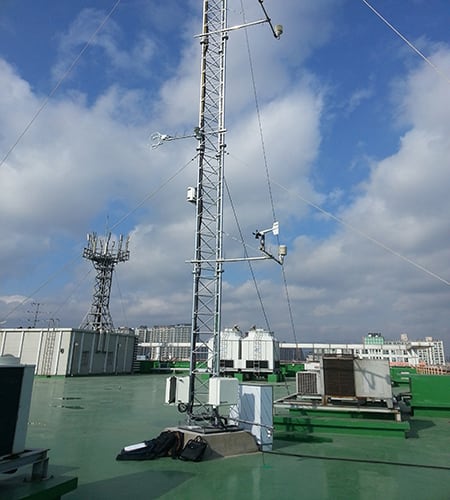
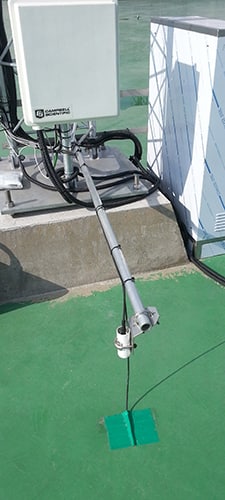
To fill this study B&P International installed seven weather stations throughout Seoul city. Six of the weather stations were installed on building roof tops, while the final station was installed in a rural area near Seoul. The stations are being used to monitor air temperature, humidity, wind, net radiation, CO2/H2O concentration etc. as well as building surface temperature. Building surface temperature is being measured with Apogee SI-111 Infrared Radiometers, temperature probes, and infra-red cameras.
Data collected from the temperature probe and the SI-111 at the same site are being compared and analyzed. The SI-111 is being used as the standard for accuracy, as measurements from the temperature probe may be heated by solar radiation. As the data is collected, it is transmitted to a computer at the WISE office using 4G LTE modems. From there the data is uploaded to the WISE website, where it can be viewed in real time for analysis. |
|

07 March 2017
Weather Information Service Engine Project (WISE)

06 December 2016
Peter Sinks
|
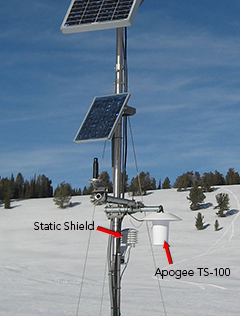
The TS-100 has been deployed for the past year on a weather station at a record-setting cold location in the contiguous United States - Peter Sinks, Utah. It is used to accurately measure the extremely cold air temperatures that occur at the site. The Peter Sinks site uses two yellow-bead thermistors and two PRTs in an Apogee TS-100 to make replicate measurements. Note the Apogee SP-230 all-season pyranometer in the picture as well.
|
|